
Note: This post contains affiliate links. If you book through them, I may earn a small commission at no extra cost to you. I only recommend things I have personally used or genuinely believe in.
One of the greatest and finest of cities, and most perfect of them in beauty – Ibn Battuta, the OG Traveller (on his visit to Samarkand, Uzbekistan around 1333)
I stood in the center of Registan Square and realised that, for once, reality completely dwarfed the postcards.
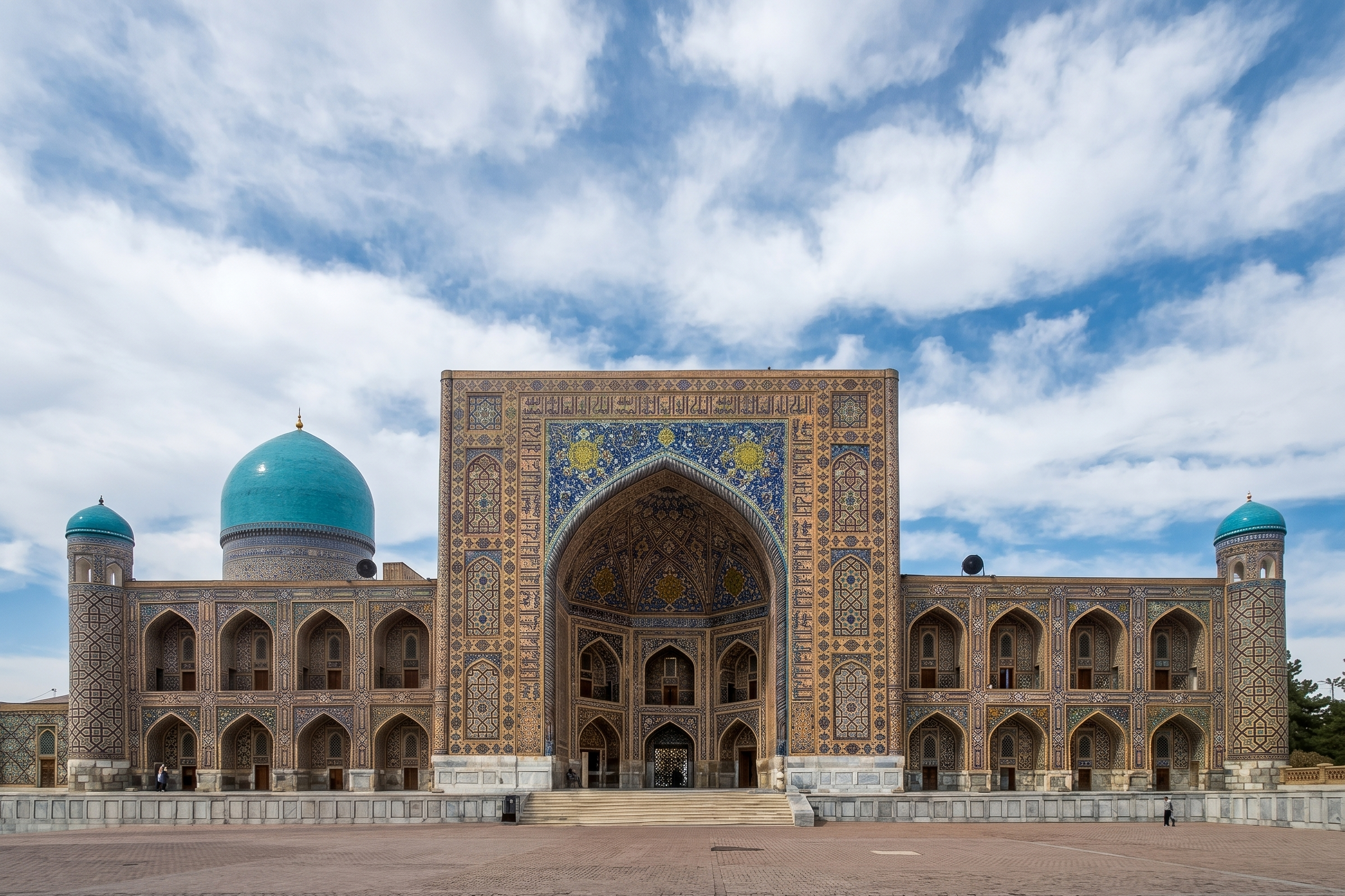
The scale of the three massive madrasas is impossible to grasp until you are actually there, standing still, feeling very minuscule against centuries of architecture that has quietly outlived empires.
Most people come for the photos. I found myself staring at the imperfections instead – the gaps between the tiles, the uneven lines, the quiet evidence of time passing over something that refused to crumble.
This is my honest account of three days in Samarkand, Uzbekistan, and why it has stayed with me longer than most trips do.
👉 Must read: What Uzbekistan Really Cost Me
Arrival: Finding Home at the Foot of Gur-i-Amir
My best friend and I had arrived that morning on the Afrosiyab from Tashkent, the world’s cheapest bullet train, pulling into Samarkand just before 11 AM after a comfortable two-hour ride through the Uzbek countryside.
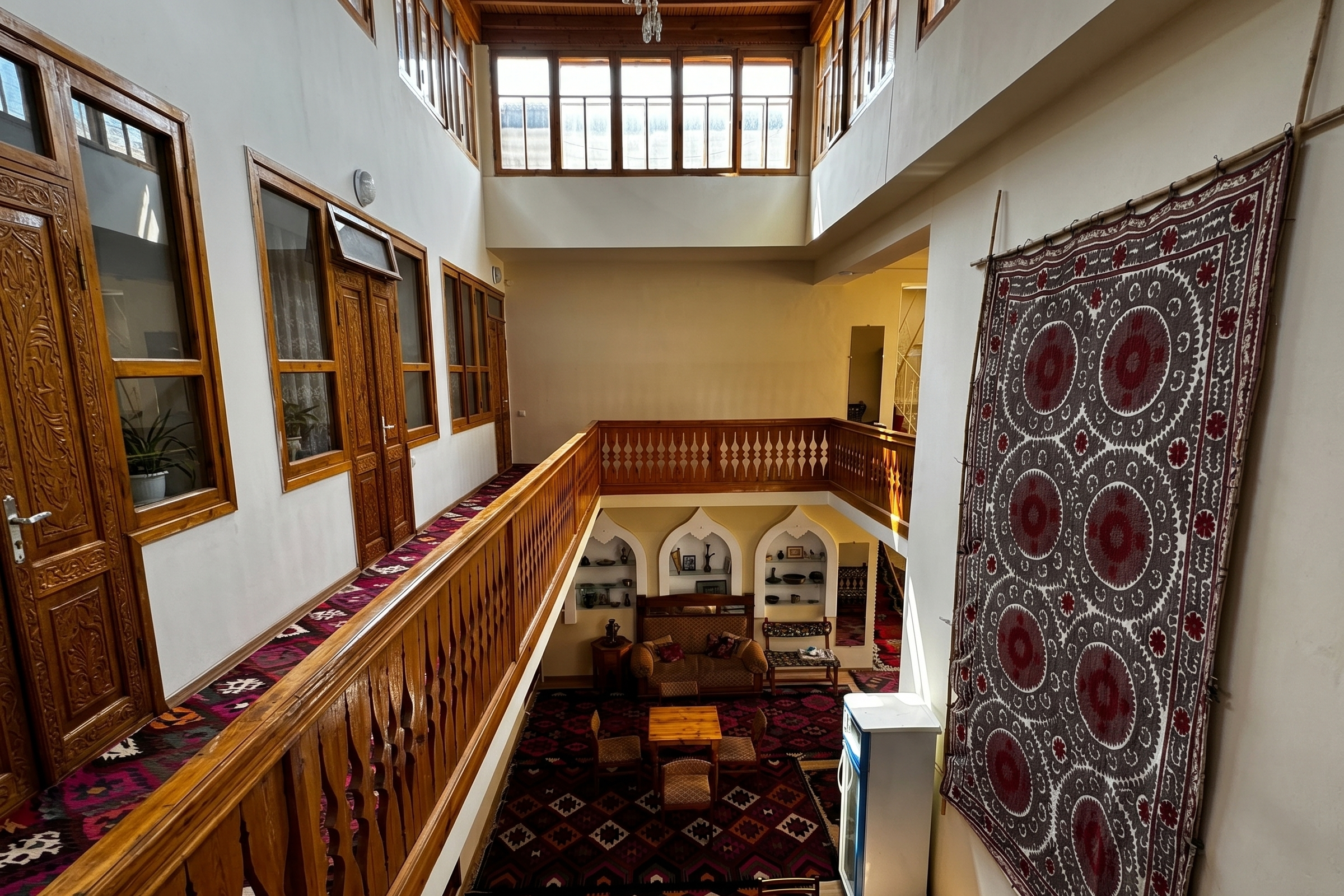
A quick cab from the station and we were at our small B&B, a small family-run guesthouse tucked into a quiet residential street in the old city, with traditionally decorated rooms arranged around a shaded inner courtyard and an undisturbed view of the Gur-i-Amir Mausoleum right from the window.
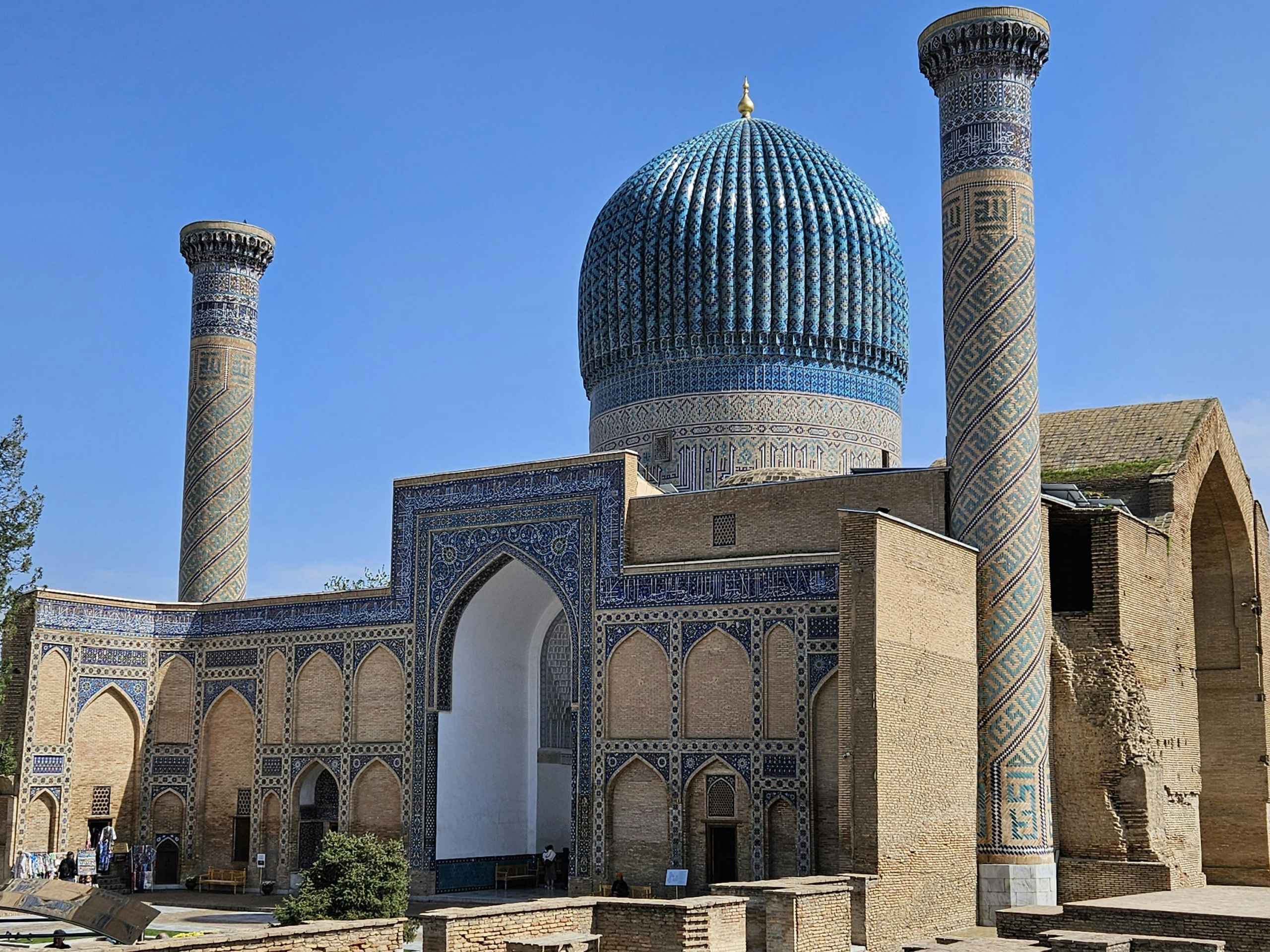
I stood at that window for a moment longer than necessary.
That tomb belongs to Amir Temur, or Tamerlane as history also knows him – the 14th-century conqueror who chose Samarkand as his capital, who rebuilt a city that Genghis Khan had reduced to rubble, and who filled it with the most extraordinary tilework the medieval world had ever produced.
The cobalt and turquoise you see everywhere in Samarkand, the particular shade that photographs poorly because nothing quite captures it, is largely his legacy.
Bread, Optical Illusions, and Ancient Astronomy
After gawking at the Mausoleum for what was probably a couple of minutes but felt like a lifetime, we freshened up and headed out with no particular plan, just hungry and curious, walking in the general direction of whatever the city wanted to show us first.
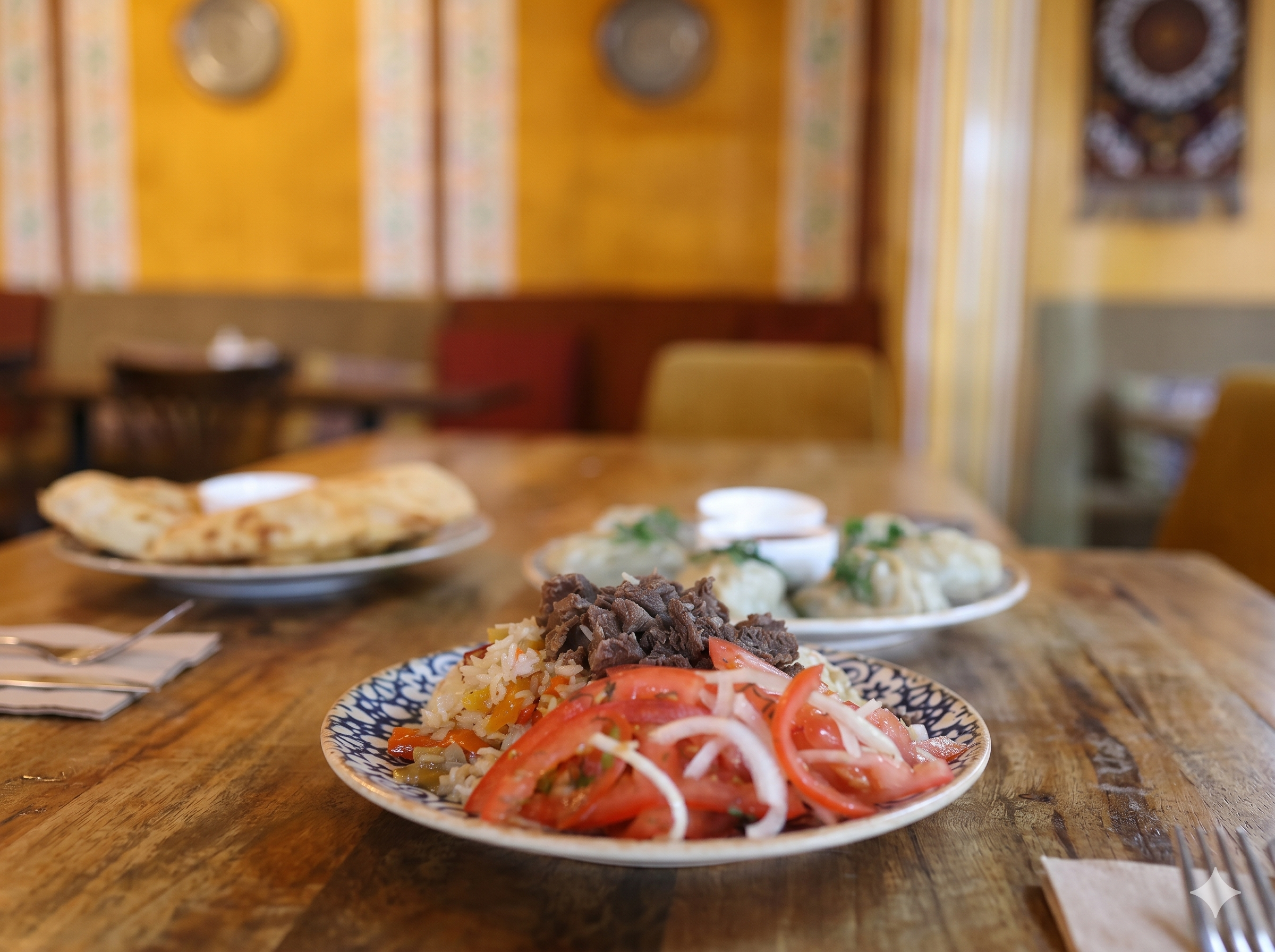
We found a small local eatery the way you find the best ones everywhere – by following the locals. A handful of tables, no menu in any language we could read, and a plate of pilaf that arrived without much ceremony and tasted like it had been perfected over a thousand years. Rice cooked with lamb and carrots and spice, warm and heavy and completely right. The non bread came with it, enormous and golden.
We ate too much and then decided to walk it off, in no particular direction. That unhurried stroll is what eventually brought us to Registan Square (it was in the plan somewhere, but not on that first afternoon).
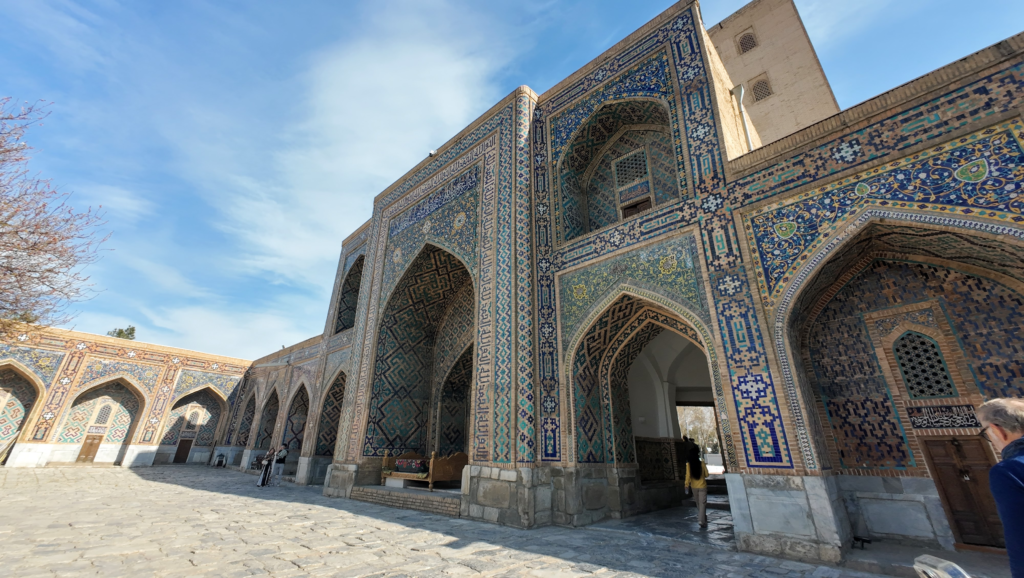
Three madrasas arranged around a single open square, each one covered in tilework so intricate and so impossibly scaled that your brain genuinely takes a few seconds to accept what your eyes are reporting. The grounds are vast enough that even with other tourists around, we could barely hear anyone. There was a strange hush to it, like the architecture itself was absorbing all the noise.
The Tilakari Madrasa in the center stopped me completely with its gilded interiors – a ceiling so dense with gold leaf and painted patterns that it feels almost excessive until you realise it is also an optical illusion. The dome appears to curve upward in a perfect arc, but the surface is actually flat, the concentric patterns tricking your eye into seeing depth that isn’t there.
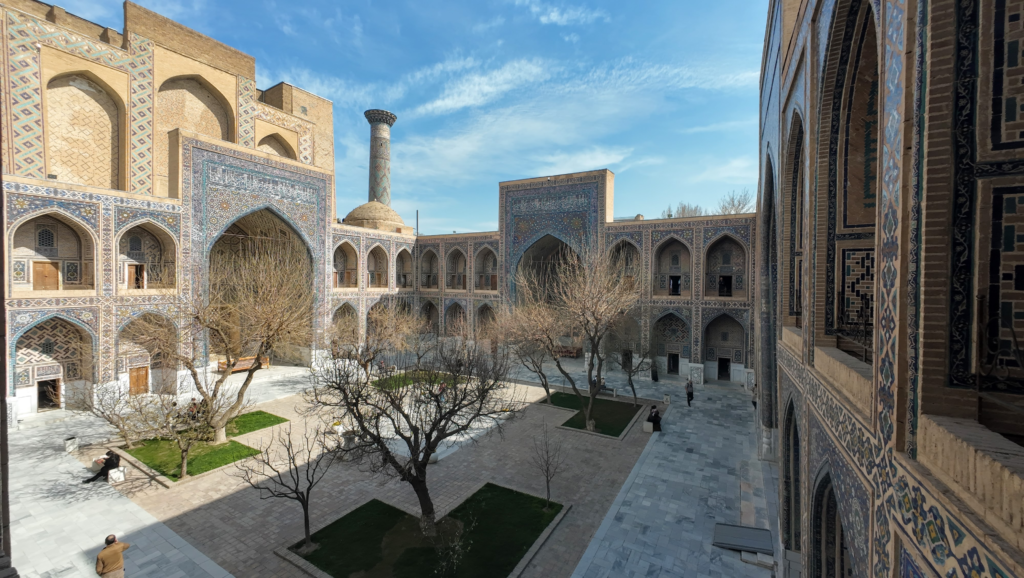
Ulugbek’s Madrasa to the left carries the starry motifs of Temur’s astronomer grandson, a man who loved astronomy more than power, who taught mathematics in these very courtyards and calculated the length of the year to within a minute of what modern science confirms.
The Sher Dor Madrasa to the right is the one I kept coming back to. Its facade depicts felines chasing deer – a deliberately Zoroastrian image on an Islamic building, placed there without apology, which tells you something about the layered, complicated, genuinely fascinating history of this city.
We spent hours inside without noticing. Time loses its edges in that square.
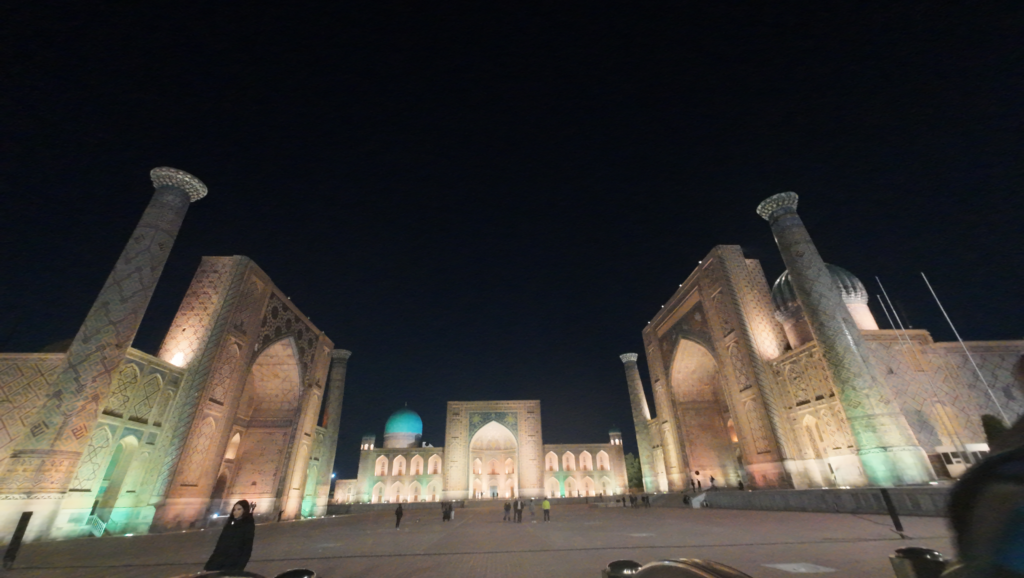
I went back in the evening just to watch it light up. The floodlights turned the sandstone warm gold, the turquoise dome behind glowed against a black sky, and I stood there for a long time.
Temur’s Curse and Unrequited Love
Somewhere in the middle days of the trip, in no particular order, the city continued to reveal itself.
The Gur-i-Amir Mausoleum deserved more than the glances we had been giving it from our window. Inside, the tombs of Temur and his heirs sit beneath one of the most beautiful domed ceilings I have ever been under – gold and lapis and geometric patterns so dense they become almost meditative.
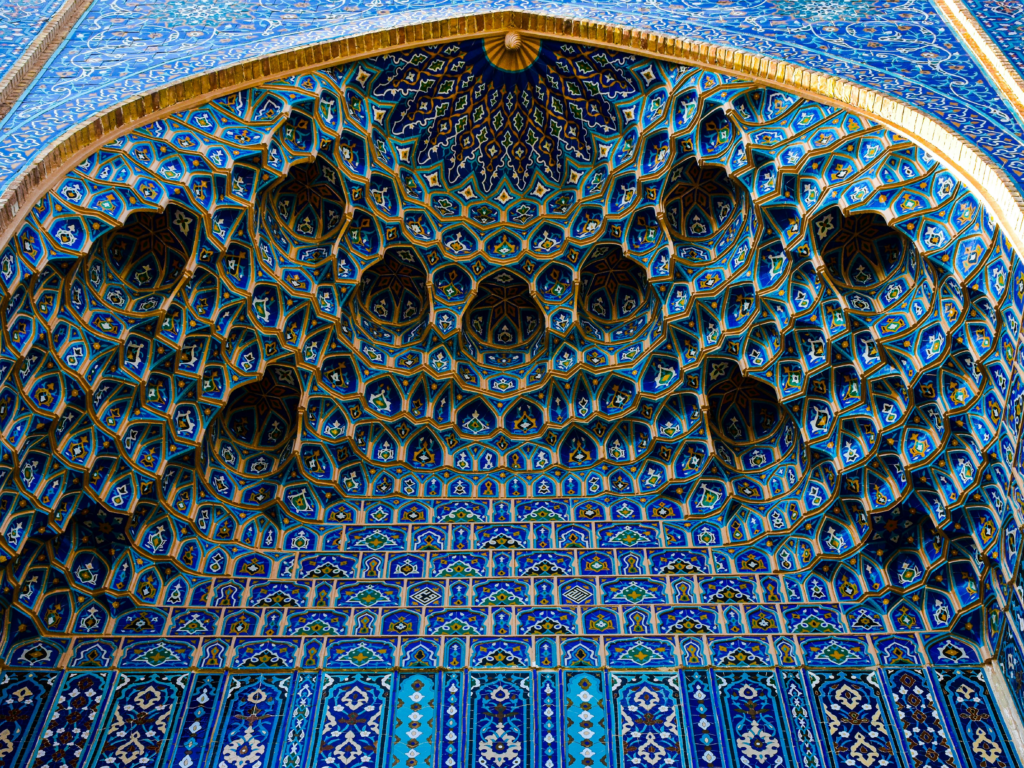
What stops you, though, is the tomb itself. An inscription on Temur’s grave reportedly reads: whoever opens this tomb will be defeated by an enemy more fearsome than me. Rumor has it that Soviet archaeologists opened it in 1941. The next day, Hitler’s armies invaded the Soviet Union.
History and myth mix freely in Samarkand. I have decided I am completely fine with that.
At the Bibi-Khanym Mosque, a vast and partially crumbling structure that Temur built using the spoils of his Indian campaigns, an elderly man near the entrance noticed us looking slightly lost and pointed us in the right direction – there was no transaction, no expectation, just a polite smile and a gesture. It happened more than once in Samarkand, and by the second day, I had started to expect it.
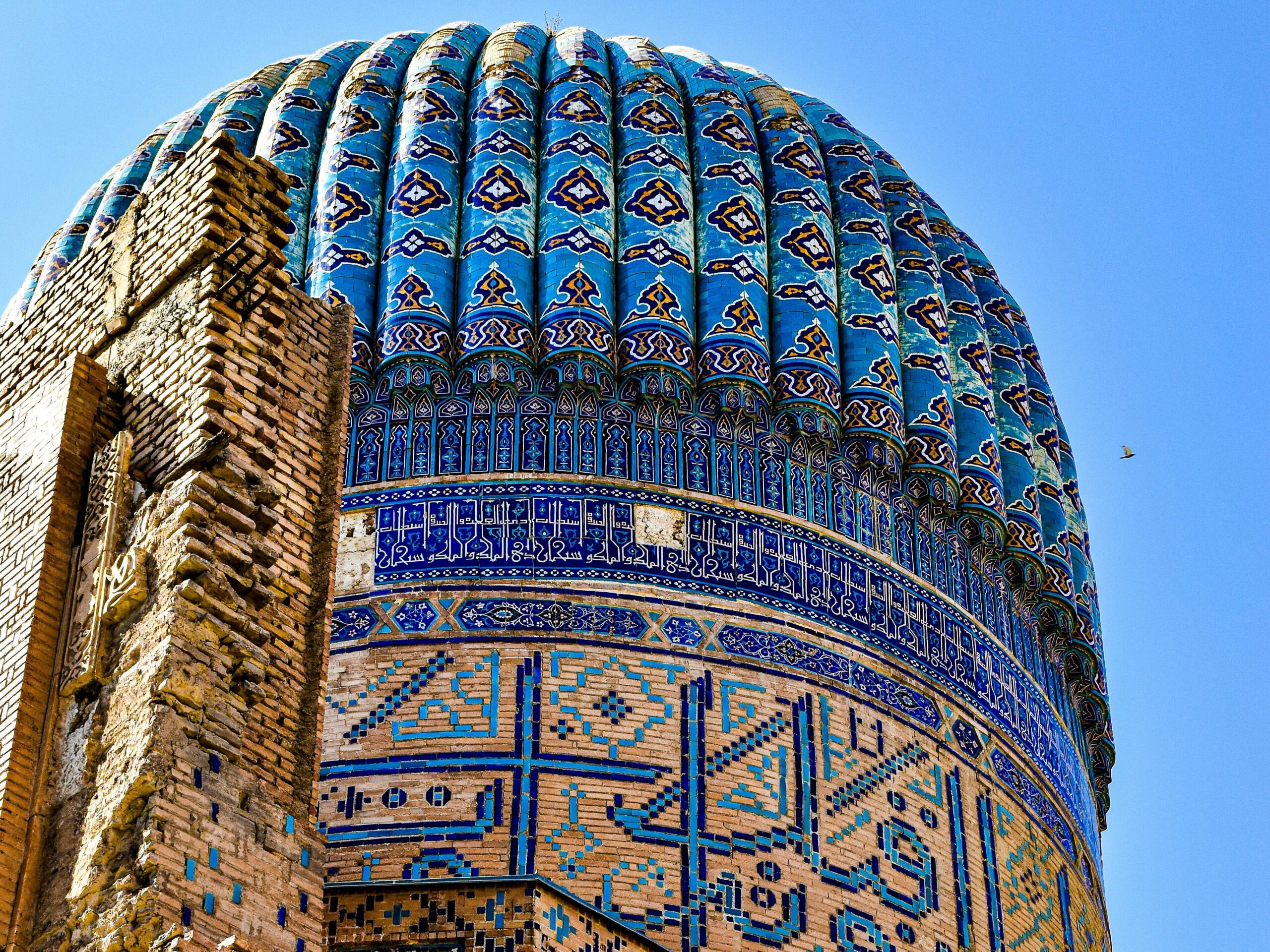
The mosque comes with its own legend, and it is a good one. While Temur was away at war, the architect overseeing the construction fell in love with his wife Bibi-Khanym and refused to finish the work unless she gave him a kiss. She agreed, wanting the mosque completed. But the kiss left a mark on her face that she had to hide with a veil.
Temur returned, noticed the veil, learned everything, and had the architect killed. He also ordered the veil imposed on all Muslim women so that no man would ever be tempted again. Bibi-Khanym, facing repudiation, arrived in front of him with an empty bag. He asked what she wanted to put in it. She said, “You, because you are the only thing I care about”. He forgave her.
Whether any of this is true is probably beside the point.
Mapping Stars and Stamping Bread
The Ulugbek Observatory sits on a hill outside the city and arrives quietly, without the grandeur of the monuments in the center. What remains is mostly an excavated arc of the enormous sextant Ulugbek had built into the earth itself, 30 metres wide, used to map the stars with a precision that wouldn’t be matched for another century.
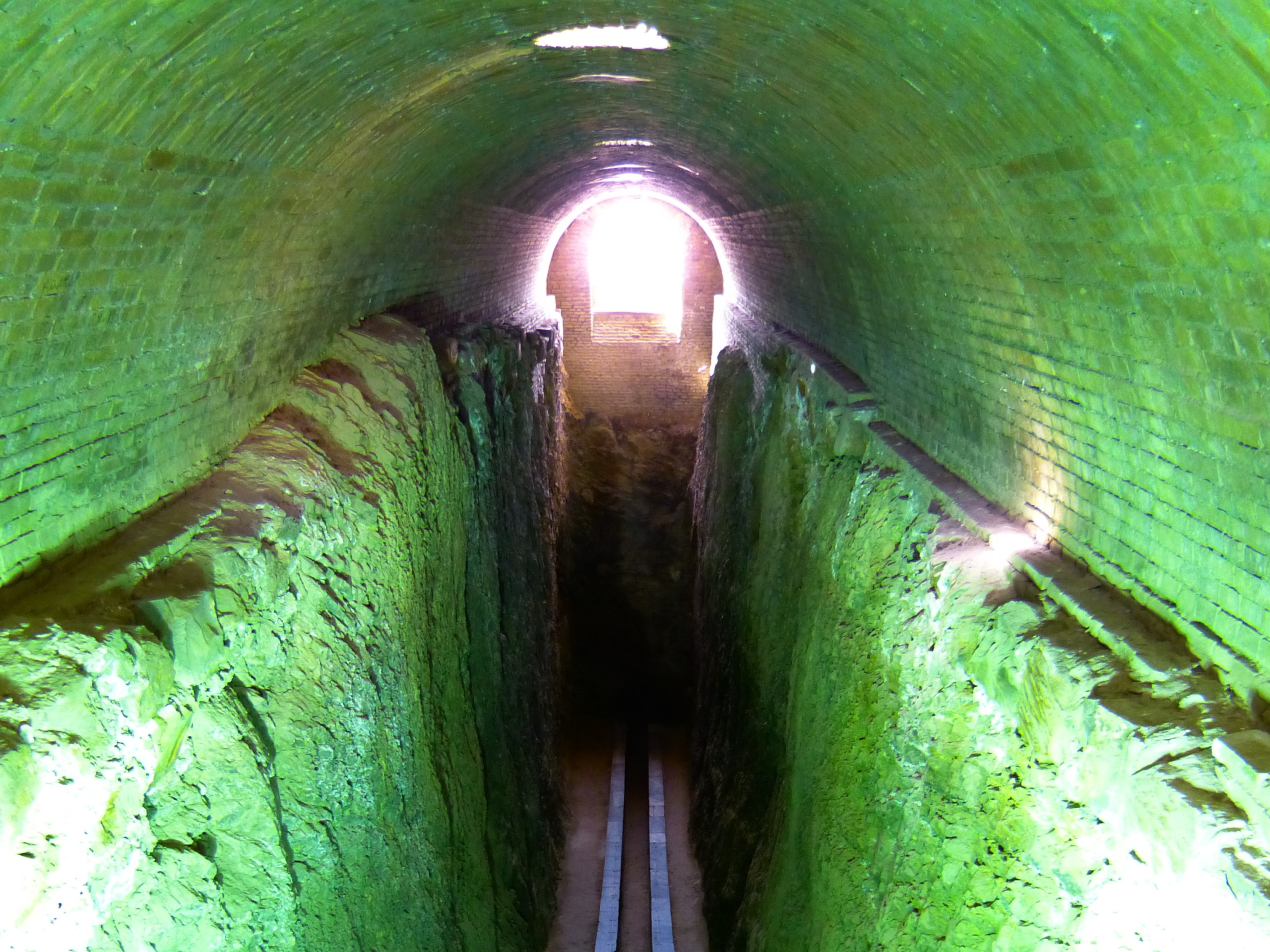
I stood at the edge of it and thought about what it means to be that obsessed with something, and about the fact that this man was eventually killed by his own son.
Siyob Bazaar happened on one of our slow mornings, and it was the most ordinary and the most alive part of the whole trip.
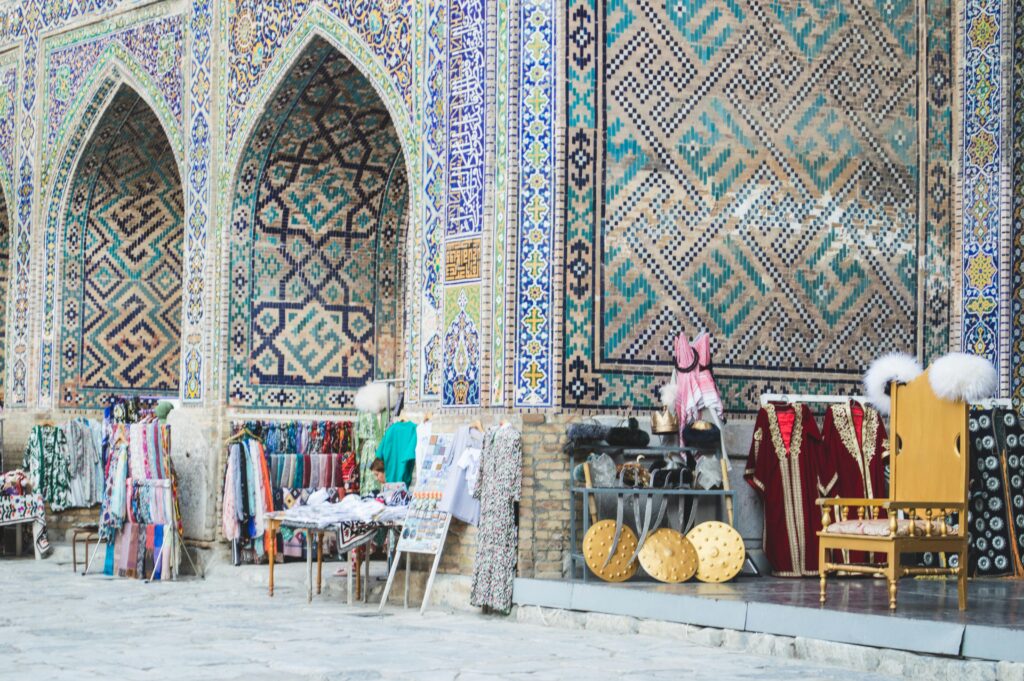
The smell hits first – local honey, cumin, something warm and smoky underneath it all that I still cannot find the right word for. The market has existed in some form for over 2,500 years, which sounds like a textbook fact until you are standing inside it watching a woman stamp a pattern into a fresh disc of non bread with the practiced ease of someone who has done it every morning of her adult life.
She caught me watching. We smiled at each other. I bought a piece still warm from her hands and ate it walking, pulling pieces off as I went, the dough tasting of woodsmoke and yeast and something I have not stopped thinking about since.
👉 Must read: Riding the World’s Cheapest Bullet Train
The Living King and the Hall of Blue Mirrors
If I had to preserve only ONE moment from my entire 10-day adventure in Uzbekistan, I would, undoubtedly, a hundred times over, choose the moment I stepped foot inside the grounds of Shah-i-Zinda.
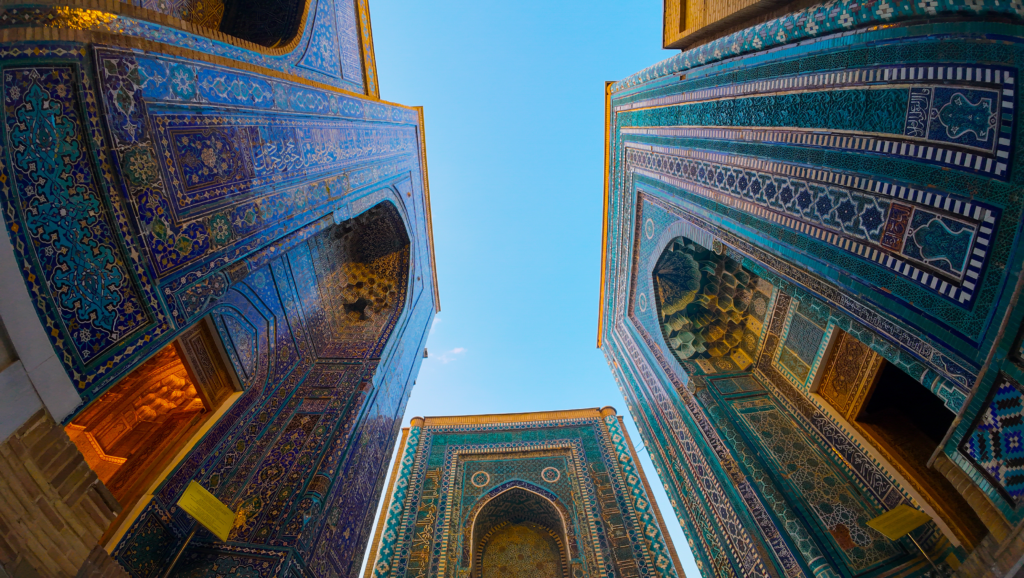
The landmark is not just a collection of tombs; it is a blue-tiled dreamscape that feels entirely detached from the modern world outside its gates. We timed our arrival for the late afternoon, paying the 40,000 Som entry fee, which remains one of the few instances where the price feels like a complete bargain for the experience.
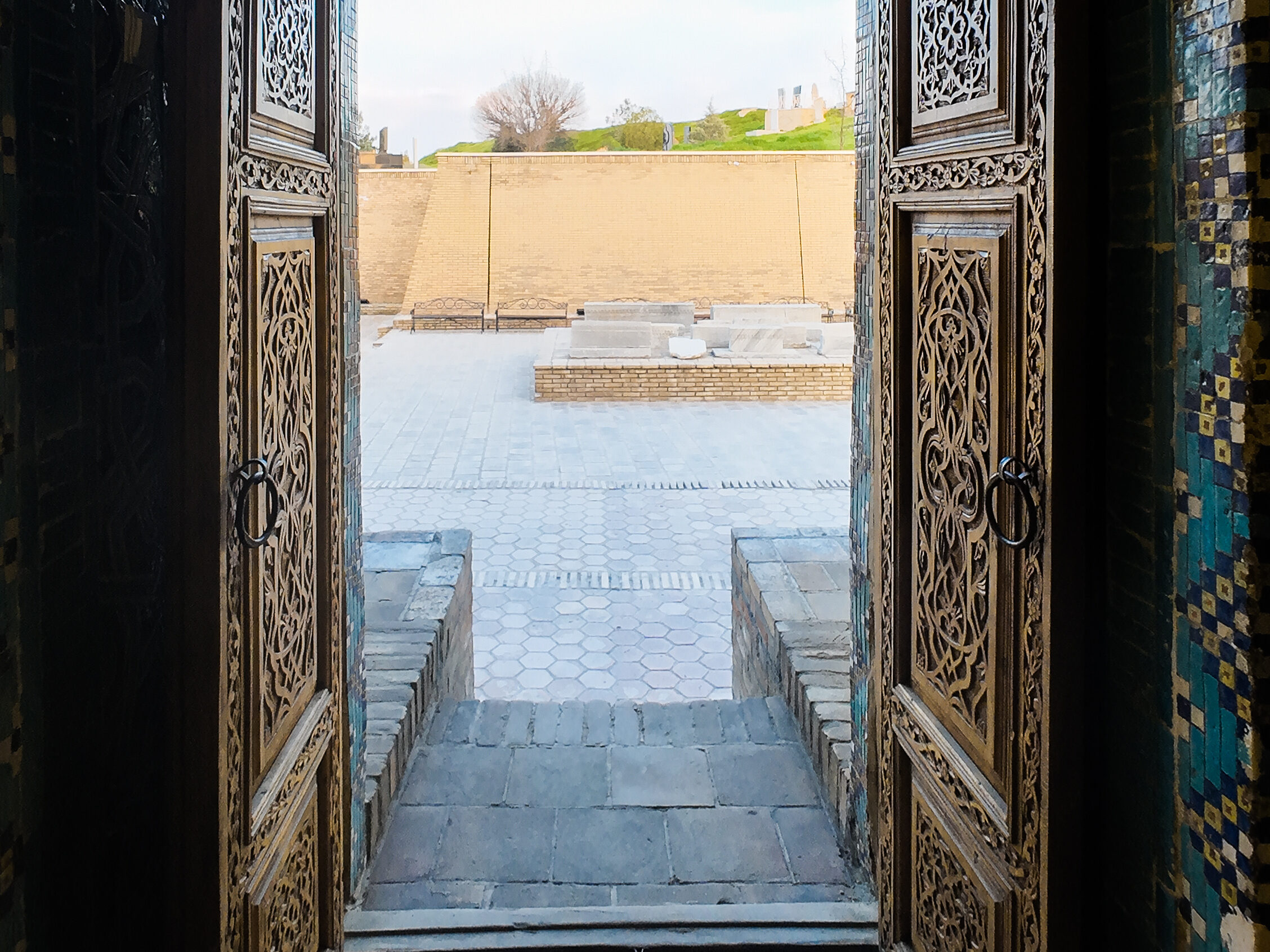
Shah-i-Zinda means Tomb of the Living King, a reference to the first mausoleum built here for Qusam Ibn-Abbas, the cousin of the Prophet Muhammad, who, according to local belief, did not die but retreated into a well and continues to live there still. Temur and Ulugbek later buried family members along the same corridor, decorating each tomb with tilework that became among the most extraordinary in the Islamic world.
The corridor is narrow, lined with mausoleums that display every possible shade of lapis, turquoise, and sapphire. I reached out to touch the cool, glazed ceramic of a 14th-century wall and felt a strange sense of stillness.
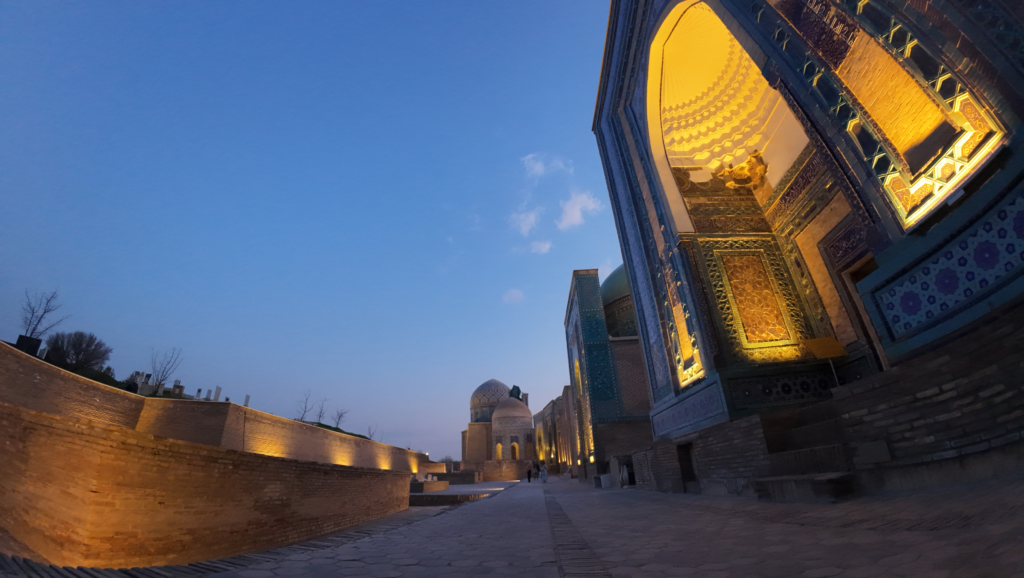
By some miracle, the crowds had thinned out until it was just my friend and I standing in that sea of blue. The Golden Glow of the sunset hit the tiles and turned the entire walkway into a hall of mirrors, reflecting light in a way that felt almost regal.
I sat on a stone step and watched the shadows stretch across the ancient brickwork. Finding this kind of peace in a city that has seen the rise and fall of empires is a rare gift, and I stayed until the turquoise shifted into a bruised, midnight blue, as if I were a prisoner of this unfathomable beauty engulfing me.
Ballroom Feasts and Park Benches
Somewhere in those middle days, the city’s grander historical weight was balanced by the kind of ordinary moments that make a place feel like a home rather than a museum.
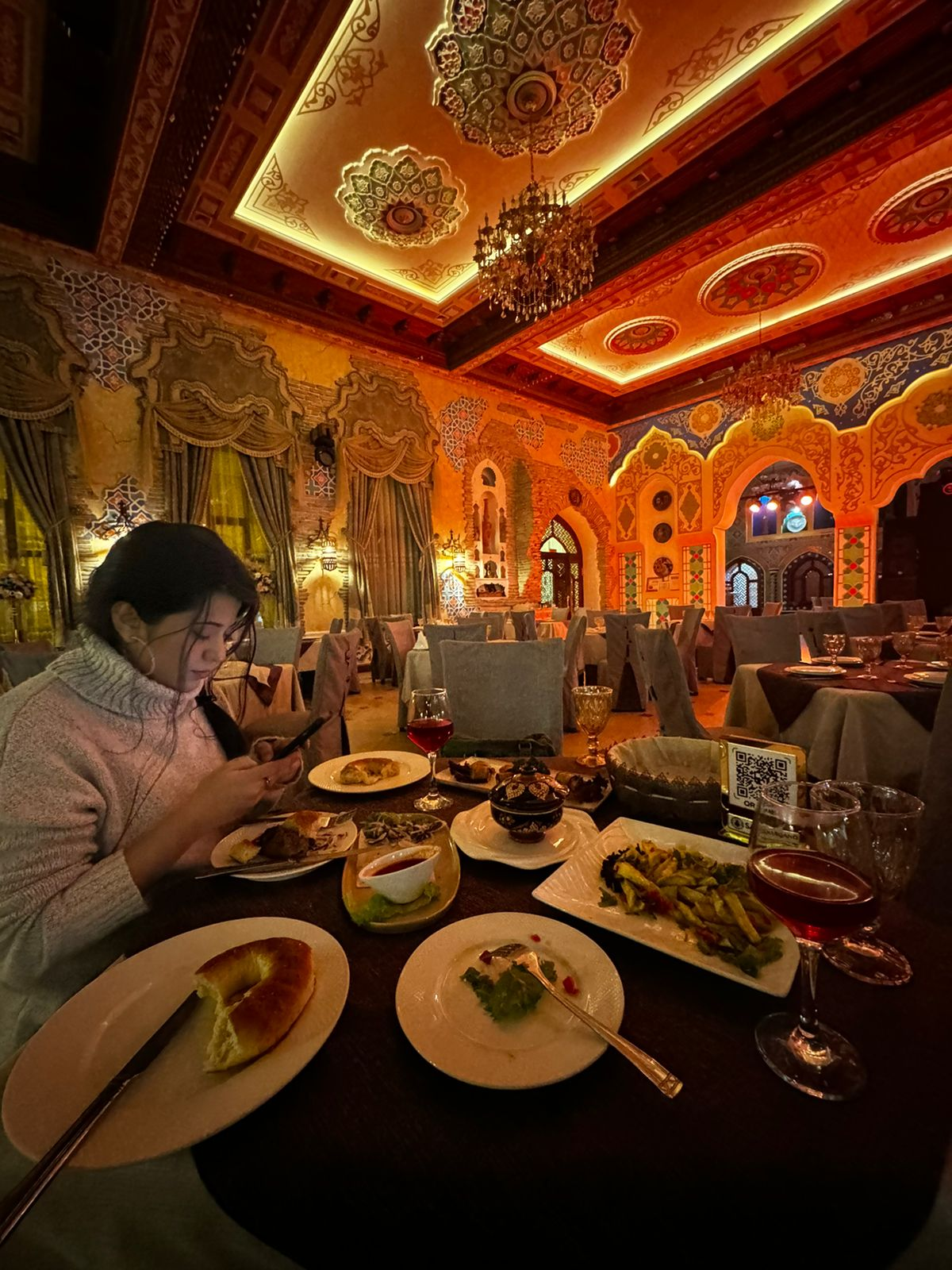
We had a proper girls’ night at the Samarkand Restaurant at some point. It is a popular spot for a reason, often playing host to elaborate local celebrations, so you definitely need to book ahead for dinner. It fills up quickly with a mix of travelers and locals dressed in their best, all there for the same legendary jiz-biz and the lively, busy atmosphere that makes the night feel special.
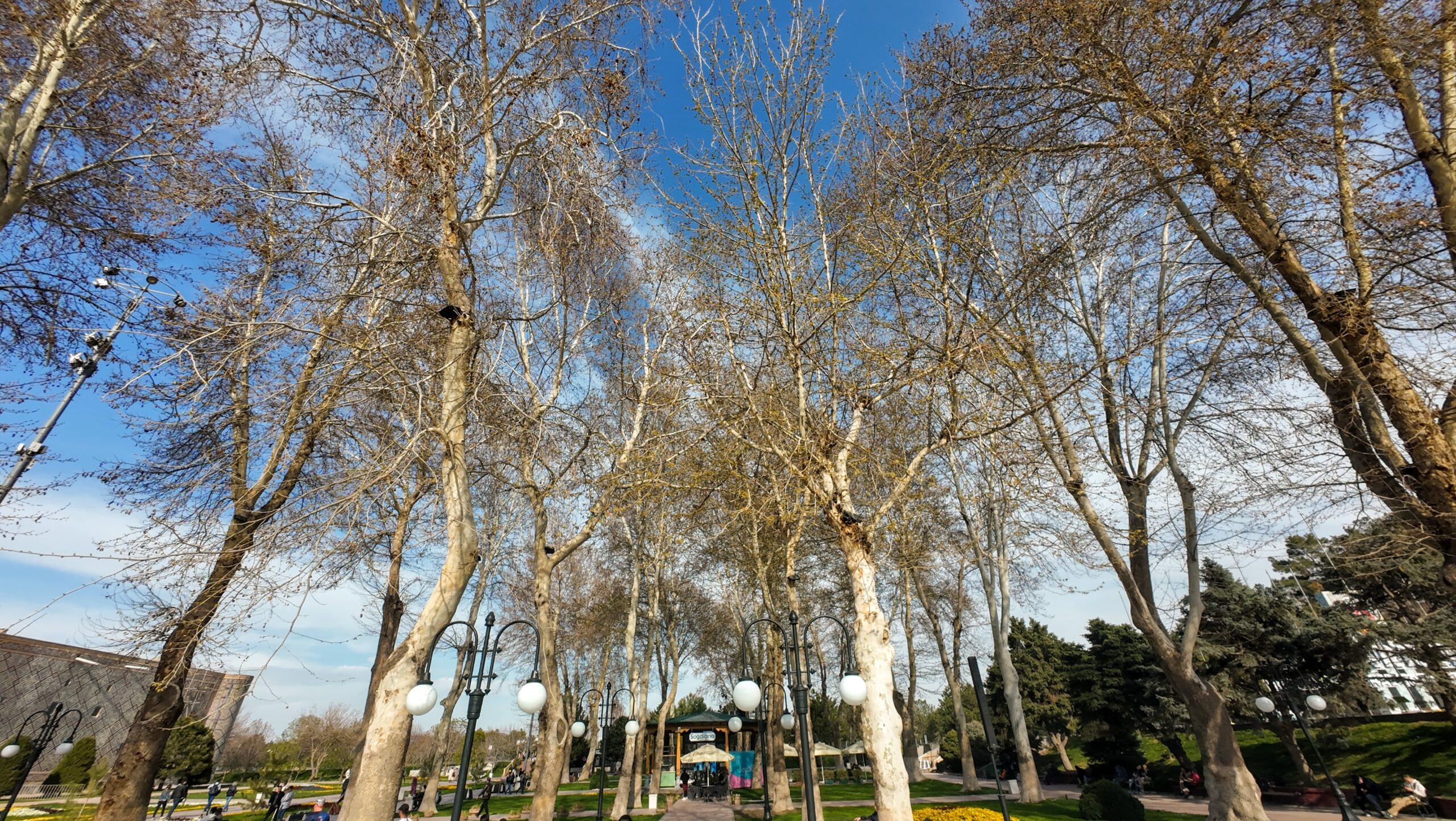
Central Park in the evening is also worth a slow walk. The city uses its public spaces well, and there is a genuine ease to how people occupy them without being cumbersome. You see families, groups of friends, and older couples all moving with a complete lack of rush, as if the heat of the day has finally broken and left everyone with a collective permission just to breathe.
👉 Also read: Bukhara Old City: The Ultimate Peaceful Sanctuary for Solo Travellers
On Feeling Safe in Samarkand, Uzbekistan
While I was traveling with my best friend this time, the city felt accessible in a way that makes Uzbekistan solo female travel safety a non-issue. The streets are exceptionally quiet, and the local community treats visitors with a protective kind of hospitality.
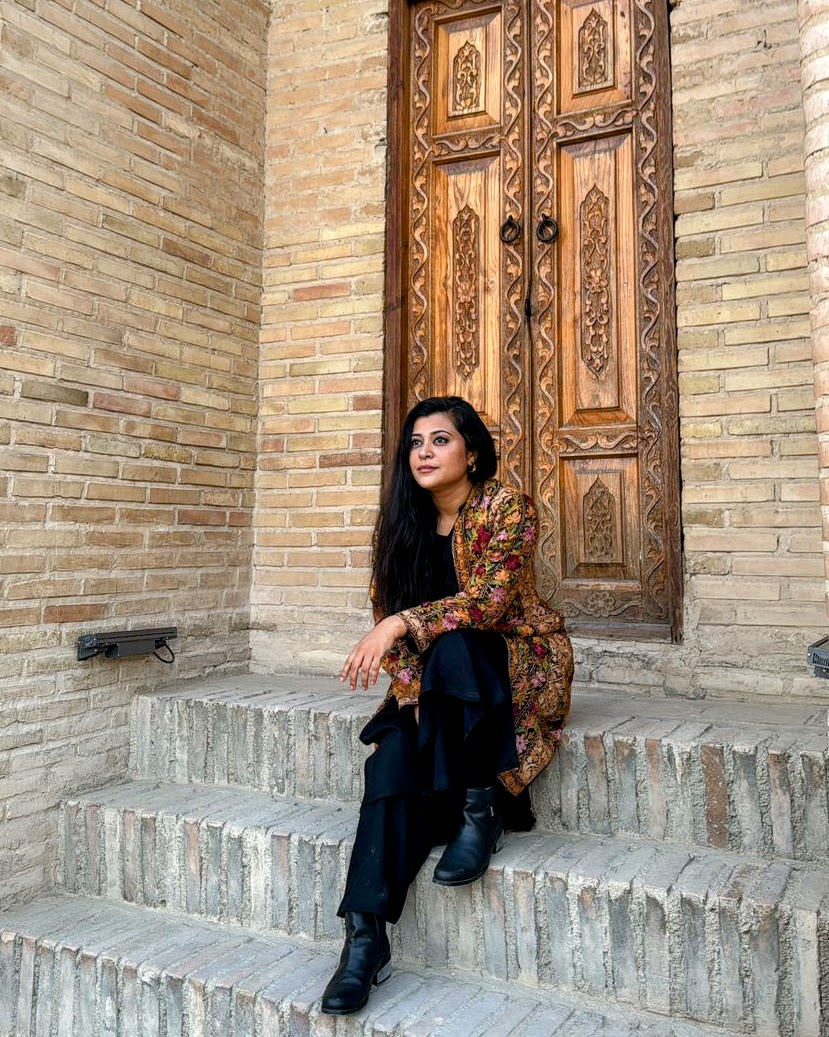
As an Indian woman who has been traveling solo for over twelve years, I know what it feels like when a place is quietly sizing you up. Samarkand never did that. We walked back through dark alleys in the old city at night without a second thought. No catcalling, no uncomfortable attention, nothing that made either of us reach for our phones or quicken our pace. Not once.
Navigating the city is remarkably simple if you use Yandex Go Uzbekistan. It removes the need for haggling over taxi prices and ensures you have a digital record of your journey, which is small but vital for peace of mind.
Know Before You Go
A few practical things worth knowing before you visit Samarkand, Uzbekistan:
- Dress modestly near religious sites – shoulders and knees covered. This is a genuinely conservative city and the ask is a reasonable one.
- Download Yandex Go before you arrive. It is the local taxi app, which removes all fare negotiation, and a 10km ride will cost you roughly 100 Indian rupees.
- Cash is useful for markets and smaller eateries. USD is widely accepted at hotels. For everything else, Som is what you need – ATMs are available in all major areas.
- Getting there: Fly into Tashkent, then take the Afrosiyab to Samarkand. Around $20 one way, two comfortable hours.
- Visa: Indians apply for an e-Visa online for $20. Three working days processing, valid for 30 days. The only tricky part is the passport photo – it must be exactly 300 DPI, 35x45mm, JPG under 1MB.
- When to go: April to June or September to early November. I went in April, shoulder season, perfect weather and lower prices.
- Most people speak Uzbek or Russian – English is limited, so download Google Translate before you land.
Final Thoughts: Would I Visit Again?
I would go back to Samarkand in a heartbeat just to sit in that blue corridor of Shah-i-Zinda one more time. There is a specific kind of magic in a place that doesn’t demand anything of you, and this city provides exactly that. Even with the blurry memories and the missed turns, the time I spent simply existing in its quiet corners felt like a necessary recalibration.
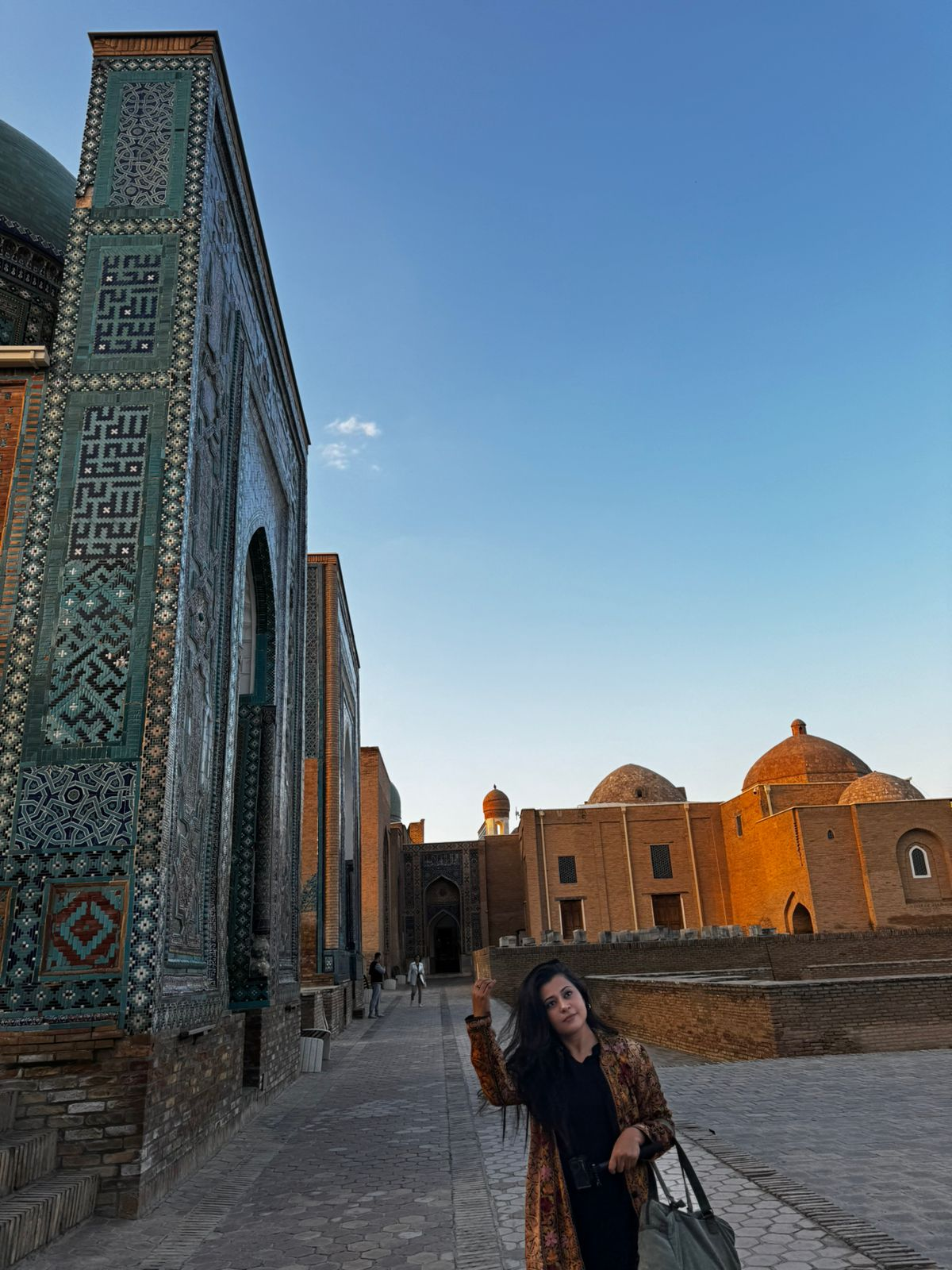
Samarkand has survived over two millennia and still somehow feels intimate. Ancient but completely alive. Peaceful but not sleepy. A city that has been destroyed and rebuilt and destroyed again and is still here, still extraordinary, which tells you something about the kind of place it is.
I went with limited time and minimal research and came away with memories that have settled deeper and stayed longer than most trips do. I want to go back knowing more – more history, more Uzbek, more of the places I didn’t reach.
This modest ode to Samarkand is my way of telling you that some legends are true, and the heart of the Silk Road is every bit as soulful as the stories promise.
Planning Your Trip?
I am gradually building a collection of Uzbekistan travel guides, budget breakdowns, and personal reflections based on my journey through the country. If you are currently planning a trip, be sure to explore the rest of the Uzbekistan collection for practical tips, train travel advice, itinerary ideas, and detailed destination guides.
If you have not joined the Hippie Souls Society yet, this might be a good time to do so. I only show up in your inbox when I have something genuinely useful to share—whether that is a new destination guide, a travel story, or a lesson learned somewhere along the way.
Questions? Feel free to reach out anytime. I am always happy to help with what I know from recent experience.
You can also connect with me on Instagram if that’s easier.
And if any of my posts help your travel plans in any way, don’t forget to leave a short comment below. It helps a small independent blog grow and always makes my day.

I love the format of the blog and very good descriptions with accurate pictures to it.
Also you look stunning 🙈
Thank you for your lovely words of encouragement 🫰
Actually, the one where I am sitting on the stairs, I look exactly like my mum in her younger days. Thank you again, btw.